


On trust, culture and the conversations that actually build both.
I recently checked in with my friend Philippa Hann. She’s nearly a year into her role as CEO of Paradigm Norton now and I was fascinated to hear what she’s learned in that time. She’d been reflecting on what her team were really watching for in her leadership, and she distilled it down into these two questions:
“What does good look like around here?” and “Do you mean what you say?”
Philippa Hann, CEO, Paradigm Norton
They really got me thinking. These two questions are so simple on the surface, but as I’ve sat with them, I’ve realised just how much is contained within them and why they matter so much.
The gap between what we say we stand for, and what we actually model, tolerate, and reward day to day is where culture either holds strong or quietly unravels.
The words on the wall
Most organisations have values these days. They’re on the website, in the staff handbook, sometimes even painted on the wall. Words like Integrity. Collaboration. Trust. Creativity. Care.

I was interested to read some research recently though, that found only around 10% of organisations have defined what those values actually look like in practice. The behaviours that define your culture, or in Philippa’s words, “What does good look like around here?”.
In these organisations everyone is very clear about expectations and we avoid what Netflix calls the “talented jerk” problem.
Have you ever had a colleague or employee who is talented, driven and gets through an extraordinary amount of work but they also talks about colleagues rather than to them. Perhaps they quietly undermine a project they disagree with by withdrawing effort or stirring things up with colleagues (rather than airing concerns openly). Maybe they shape narratives around situations to suit their own position?
The team sees it and the leader tries to ignore it. It’s allowed to continue.
The justification for this is usually some version of: “we need them right now,” or “it’s not that bad,” or “they’re difficult but they deliver.” The pressure is real because losing a high performer at the wrong moment is costly in ways that can feel impossible to justify. But that calculation almost always misses something.
What you condone, you promote
I’m not sure where this saying originated, but leadership coach James Heale cites it often. Every time a behaviour is tolerated, the message goes out to the rest of the team: this is actually what we value here. Those values on the wall become a source of cynicism rather than guiding principles.
Trust – the real kind, built in small moments, marble by marble – starts to drain away.
This is a systems problem, not just a people problem
The management theorist Russell Ackoff had a useful way of thinking about this. The best-performing system, he says, isn’t the one made up of the best individual components. It’s the one whose components work best together.
Let’s think about something close to home. Consider a financial planning practice that invests in a best-in-class CRM, a market-leading cashflow modelling tool, perhaps a world class client portal and an AI notetaker.
While all of these are best in class, none of them talk to each other. 
The result? Re-keying data in multiple places, duplication, manual errors, and hours of wasted time every week.
The individual components are impressive but the system is a mess.
Culture works the same way. You can recruit the most technically gifted adviser, the most efficient administrator, the most commercially sharp director but if their values and behaviours don’t align with the culture you’re trying to build, they will damage the system. We’re back to the ‘talented jerk’ problem where the individual brilliance is real but so is the harm to the system.
The system reflects your choices. Not just who you hire, but what you overlook and what you address.
Which circles back to one of the questions which initiated this thinking: “What does good look like around here?”, if values and behaviours need to align.
The signals you’re sending
If you read my last piece, you’ll remember Charles Feltman’s four quadrants of trust: Care, Reliability, Sincerity, and Competence.
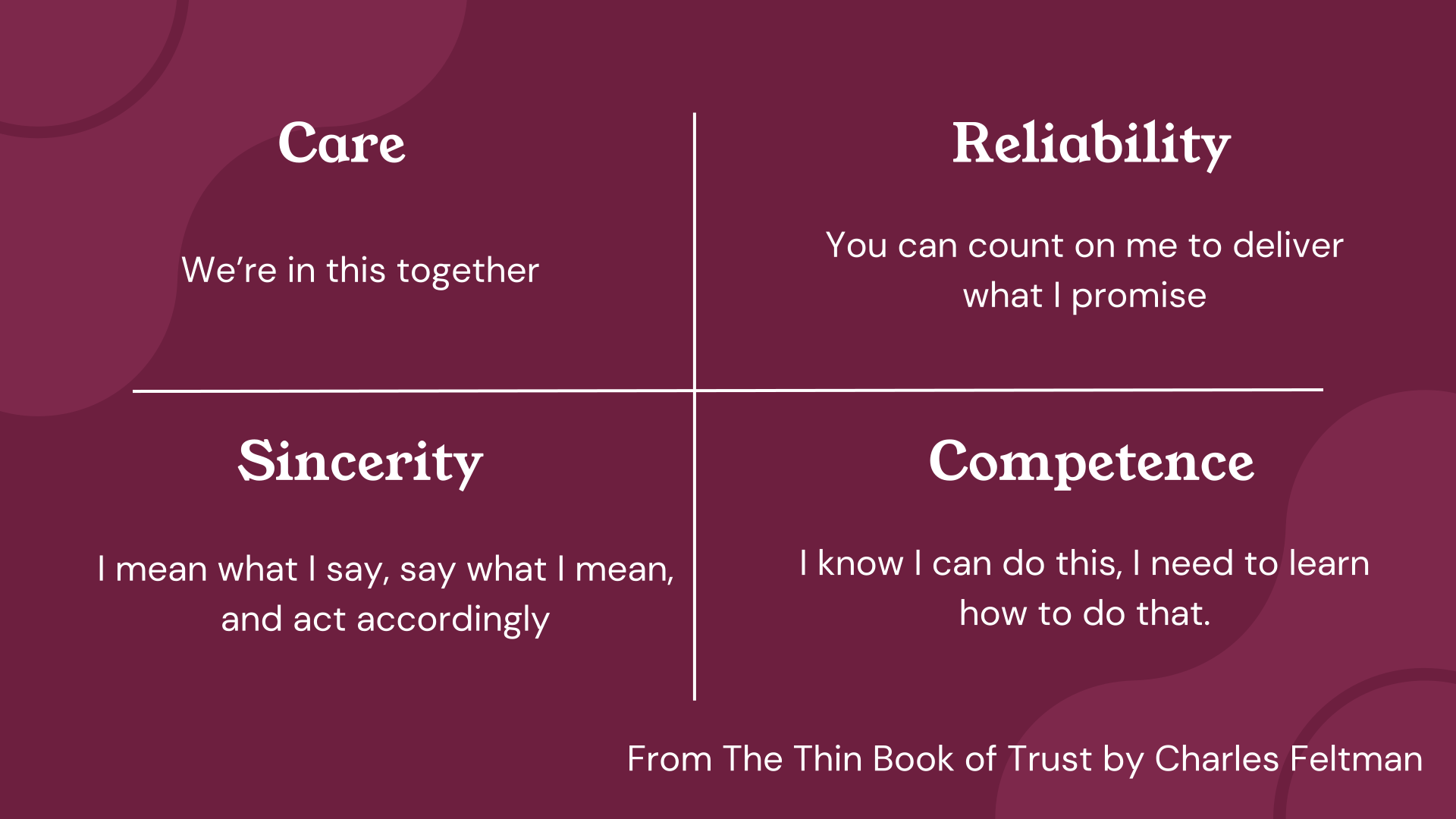
They apply just as much to how leaders behave with their teams as they do for financial planners with clients. In the case of financial planners, the biggest challenge is not to overplay the competence quadrant at the expense of the others.
In the case of leaders, the quadrant I see undermined most often, usually unwittingly, is sincerity.
Feltman defines sincerity simply:
“I mean what I say, I say what I mean, and I act accordingly.”
Charles Feltman – The Thin Book of Trust
Which sounds similar to Phillippa’s second question “Do you mean what you say?”.
When a leader declares that accountability is a core value and then fails to hold themselves or others accountable to agreed processes, sincerity breaks down.
The team notices. They always do. I wonder if it resonates for you?
How about a leader who espouses the value of growth, and says that they want to build the capacity of their team, and then jumps in with the answers before anyone else can think? That would be me, by the way – a recovering “fixer”. For a long time I genuinely believed that having the answer quickly was how I added value. What I didn’t see was what it communicated to the people around me: that their thinking wasn’t really needed. It undermined them and in doing so I undermined my own messages.
Think about the manager who says they value diversity of thought and recruits someone for the considered perspective they bring to problems and then go on to run meetings where the new recruit isn’t able to share their point of view because they’re drowned out by louder voices. What a missed opportunity.
All of these behaviours send signals. The impact isn’t intended but intention isn’t the measure here.
“What does good look like around here?”
This isn’t about values, it’s about behaviour. Spend time defining what your values look like in practice, preferably together with your team. That’s your culture and it sets clear expectations for how the system of your organisation runs.
Here’s a practical example, using the value of trust as it’s the subject of this article. I see this as a core value for many financial planning firms too – it’s so fundamental to the client relationship after all.
But trust as a value is too abstract to be accountable to. Trust as a set of specific, visible behaviours on the other hand, is something people can grasp and be held to.
So we might break it down as:
- We speak to people, not about them. When something needs to be said, we say it to the person, clearly and kindly. We don’t let difficult conversations happen in corridors or in private messages.
- We own our mistakes and speak up when we don’t know. We learn from each other. We don’t blame and shame, and we’re honest about the limitations of our understanding.
- We deliver on our promises, and manage expectations honestly when we can’t. If a deadline is going to slip, say so early. Reliability isn’t about being perfect. It’s about being honest.
“Do you mean what you say?”
Answering this question for your team, is an exercise in trust-building in and of itself.
However, once we’ve defined what good looks like, it’s vital that we:
- Model those behaviours and seek feedback so we’re held to account when we inevitably slip up
- Address behaviour that contradicts them – not with a heavy hand, but with consistency, clarity and kindness
None of this is complicated but that doesn’t make it easy.
Simple to understand. Hard to do.
I think a lot of leadership content glosses over this bit so I want to be super clear. Although many organisations fail to do it, answering Philippa’s first question is fairly straightforward.
Defining your values in behavioural terms is a pretty quick win with far reaching benefits for you as a leader, your existing team, new joiners and ultimately your clients too.
The harder part, that really needs you to dig in, is changing the daily habits that undermine the values. These are often habits you don’t even realise you have.
How to begin?
Two of the practices I teach, drawn from Nancy Kline’s Thinking Environment, are immediately practical here. Both are simple to describe and pretty simple to implement. Both also require consistency, practice and perseverance (and a dose of humility too!).
Think in rounds
 In a typical meeting, the same people speak first, speak most, and shape the direction. Others wait, defer, or disengage. This isn’t usually anyone’s intention, it’s just what unstructured group conversation defaults to. 30% of people do 90% of the talking. The quieter, more considered people you recruited for their thinking are just not going to shout over everyone else and fight to be heard.
That’s not a “them” problem, it’s a structure problem. Thinking in rounds changes that structure deliberately and it’s simple to implement.
A question is posed. Then, starting with a volunteer and moving in a pre-determined direction around the room, each person responds in turn while the rest of the room promises not to interrupt. Everyone is given the opportunity to contribute, to give their answer to a specific question. Nobody is put on the spot because the order is known in advance. The loudest voices don’t dominate, and the quieter ones don’t disappear.
The effect on meeting culture is immediate and often striking. People who rarely contribute start to and ideas surface that would never otherwise have been heard. The leader stops being the loudest voice in the room and feeling the pressure to have all the answers. They start being the person who created the conditions for everyone else to think well.
Listen to ignite, not to reply
Most of us, most of the time, are listening with one eye on what we’re going to say next. We’re preparing, evaluating and waiting for our turn. This kind of listening means that more often than not, we’re listening more to what’s going on in our own heads, than what the other person is saying. It leads us to look distracted, and often, to interrupt. It also quietly communicates something to the person speaking.
What I’ve got to contribute is better, more important, than what you were about to think.
 Listening to ignite means something different. It means that while someone else is thinking, your focus of attention is entirely on what they are going to think next. You put aside your internal response as best you possibly can, until they indicate that they’re finished.
By putting aside that internal reply, for as long as you are listening, you will create the conditions in which they begin to think independently and at their very best.
The quality of thinking (and therefore outcomes) that emerges when someone feels genuinely listened to and trusted to come up with their own solutions is consistently higher than what emerges when they don’t. I absolutely speak from experience!
The most concrete expression of this is a promise not to interrupt. For most leaders, this is genuinely not easy – because the urge to add, to correct, to redirect is a deeply ingrained habit. This isn’t a character flaw though but more of a habit.
Importantly, habits can be changed.
The leader who doesn’t have to say “Trust me”
Both of these practices take time to embed. Most leaders who try to implement them on their own make real progress for a while, then quietly revert. This isn’t because they stopped caring, but because changing lifetime habits under real pressure, without support, is hard. The leaders I’ve worked with who make the most lasting change do so with coaching, structured practice, and the kind of honest reflection that’s genuinely difficult to do alone.
The leader whose team will follow them into genuinely difficult change isn’t the one who says “Trust me.” It’s the one who never has to. Because their team already knows, from a hundred small moments, that they mean what they say.
So, can you answer those questions for your team?
What does good look like around here? And do you mean what you say?
Practical reflections
Think of a behaviour you have tolerated in your team that doesn’t sit comfortably alongside your stated values.
- What has your tolerance communicated?
- What would it look like to address it – not punitively, but clearly and consistently?
Then think about your last team meeting.
- Who spoke freely?
- Who didn’t?
- Was there a moment where you could have held back and created the space for someone else – but didn’t?
- What might have emerged if you had?
If you’d like to explore more about what this could look like in your team, I can help. Get in touch here and let’s talk.
Thank you to Philippa Hann for sharing the two questions which ignited my thinking here. Philippa has co-authored the book, The Fault Lines of Finance with psychologist Dr Moira Somers. It’s out in September and can be pre-ordered here.
Main photo by Brett Jordan on Unsplash




0 Comments